


Much has been said about the need for Brazil to change its monetary regime as a condition for the interest rate to be reduced substantially.
Some proposals flirt dangerously with the idea of using the Banco Central’s reserves to contain exchange-rate depreciations that will inevitably result from doubts about the viability of the new model.
We argue here that, far more than serving as a liquidity backstop for periods of dysfunction in the foreign-exchange market, reserves have the primary function of signaling that the country is able to generate foreign currency to honor its external commitments.
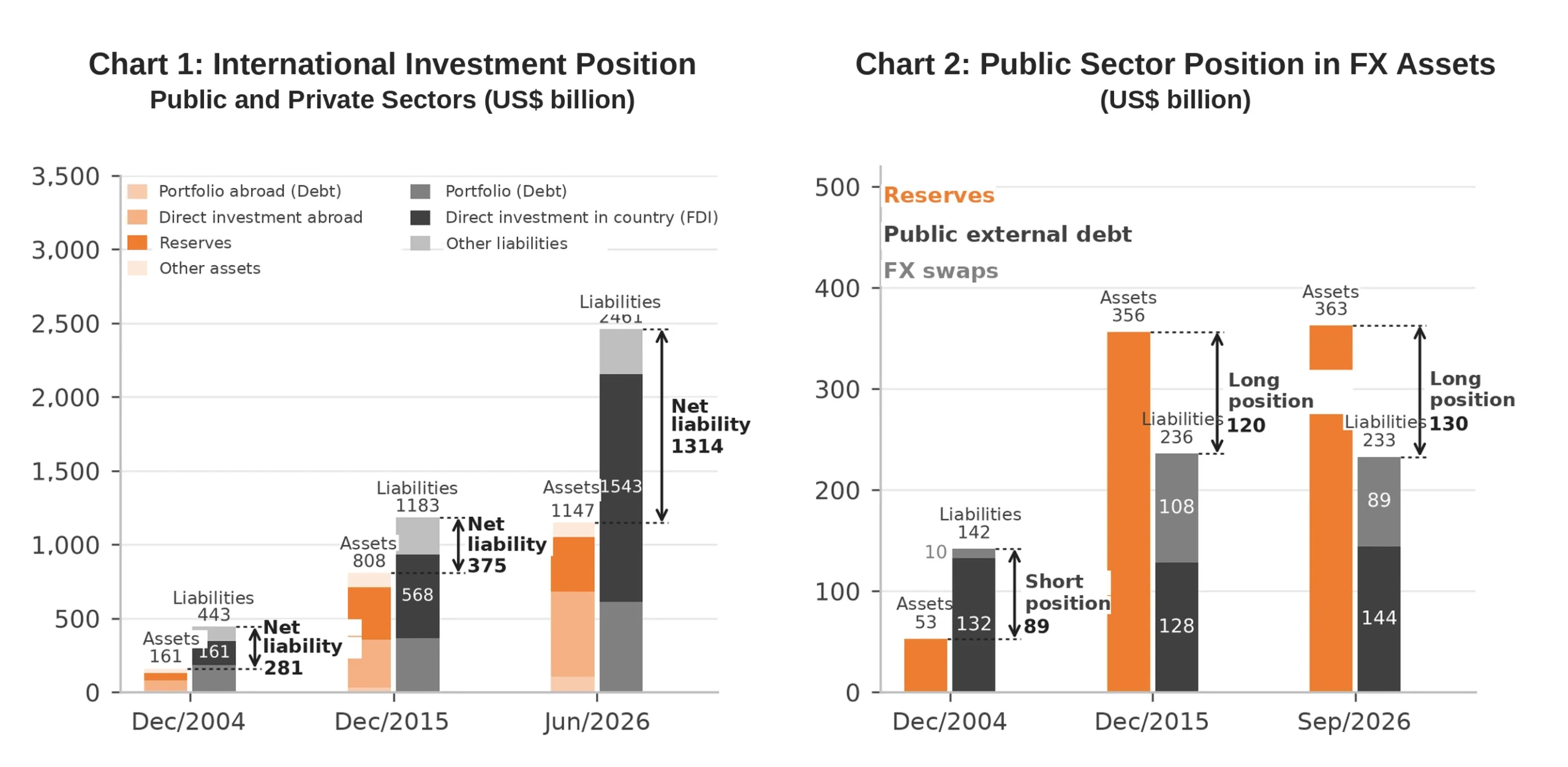
A creditor position of the public sector in assets denominated in foreign currency works as a cushion in moments of fiscal uncertainty, such as the present one. This happens because a weakening of the real reduces the net debt denominated in reais, mitigating, even if only a little, the vicious circle of indebtedness.
Introduction
Concerns about the level of the interest rate in Brazil are amply justified. Everyone is aware that the current level is extremely harmful to most households, to companies and to the government itself. But we also know that for every complex problem there is a simple, elegant and completely wrong solution. One of these would certainly be to force the monetary authority to cut the policy rate by brute force and try to contain the impact on the exchange rate by selling reserves. We argue here that reserves do not serve only to provide liquidity and contain depreciations. They are part of the net external liability and of the public sector’s position in foreign currency, and are essential to mitigate the risk of insolvency in moments of greater fiscal uncertainty.
Inflation Targets: The Anchor Is Expectations
Under the Brazilian monetary regime, the Banco Central must manage the policy rate (Selic) so as to meet the IPCA target set by the National Monetary Council (made up of the governor of the monetary authority himself, the Minister of Finance and the Minister of Planning and Budget).
The anchor of the system is expectations. If agents believe that the monetary authority will do what is necessary to hit the target, expectations converge to it. Otherwise, it is more expensive — in terms of both interest rates and output — to deliver a price change compatible with the objectives.
Any attempt to abandon the current regime implies putting another framework in its place. If interest rates are not set so as to stabilize prices, there is a risk that inflation and the exchange rate will spin out of control. The danger is that of consolidating a vicious circle involving currency depreciation and rising prices.
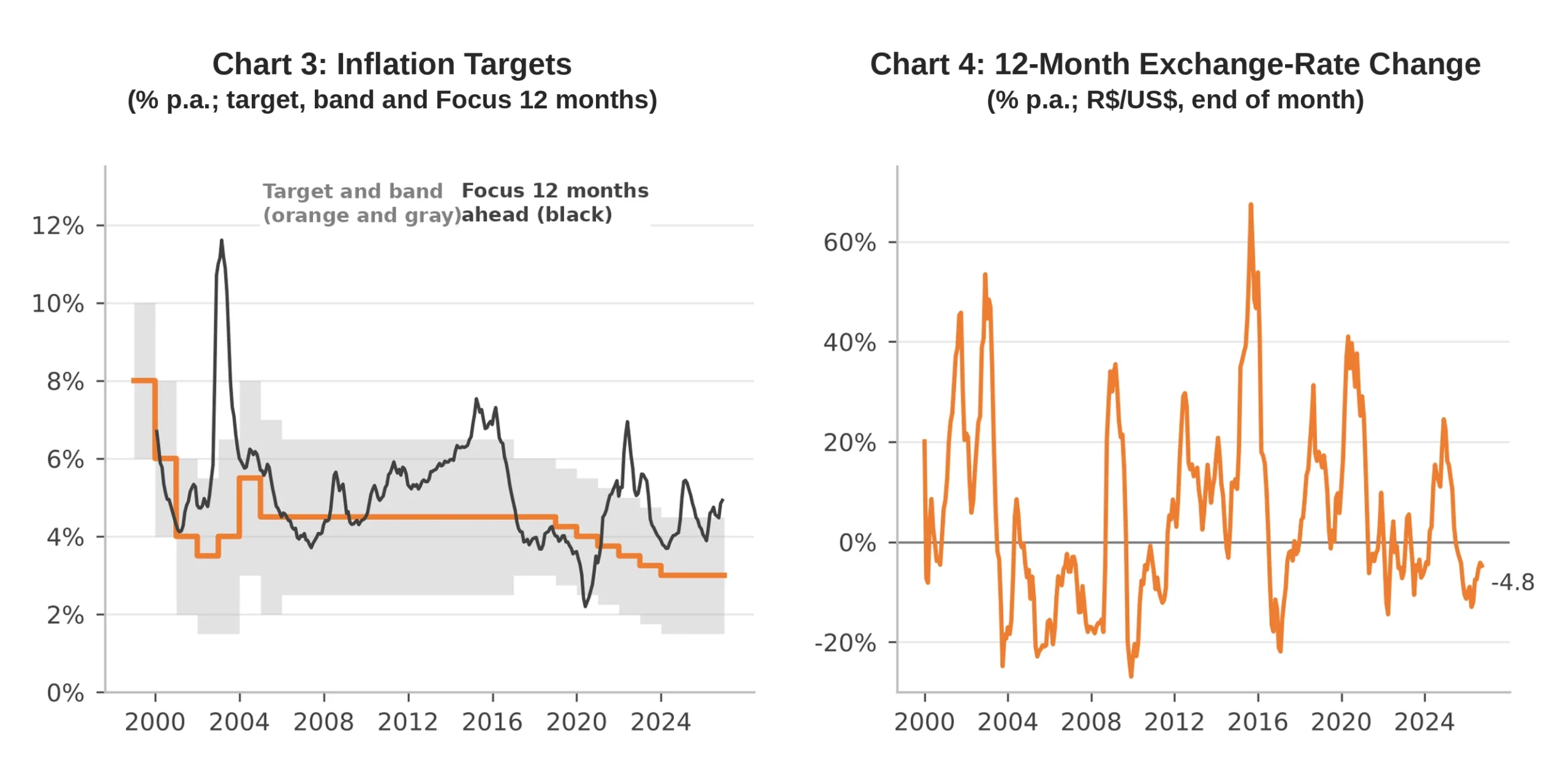
Chart 3 shows the inflation targets, the tolerance bands and market expectations for 12 months ahead. One can see that: 1) Periods of more intense exchange-rate depreciation (Chart 4) are consistent with rising inflation expectations, most of the time moving outside the target range, and 2) The attempt to reduce interest rates during the Dilma government (2011–2016) produced a loss of credibility for the monetary authority, a rise in inflation expectations and contributed to accentuating the exchange-rate depreciation.
Foreign Direct Investment vs. External Debt
The International Investment Position helps identify who the main winners and losers will be if some kind of turbulence leads to a weakening of the real. A company that has debt in foreign currency bears the cost of a devaluation because the amounts are fixed in the currency in question, and it will have to disburse whatever reais are necessary to meet the exchange rate (at the current price) when paying interest and amortizations. A company that has made direct investments in the country, by contrast, does business and books its results in local currency. If the exchange rate depreciates, its remittance abroad, when denominated in hard currency, will be smaller.
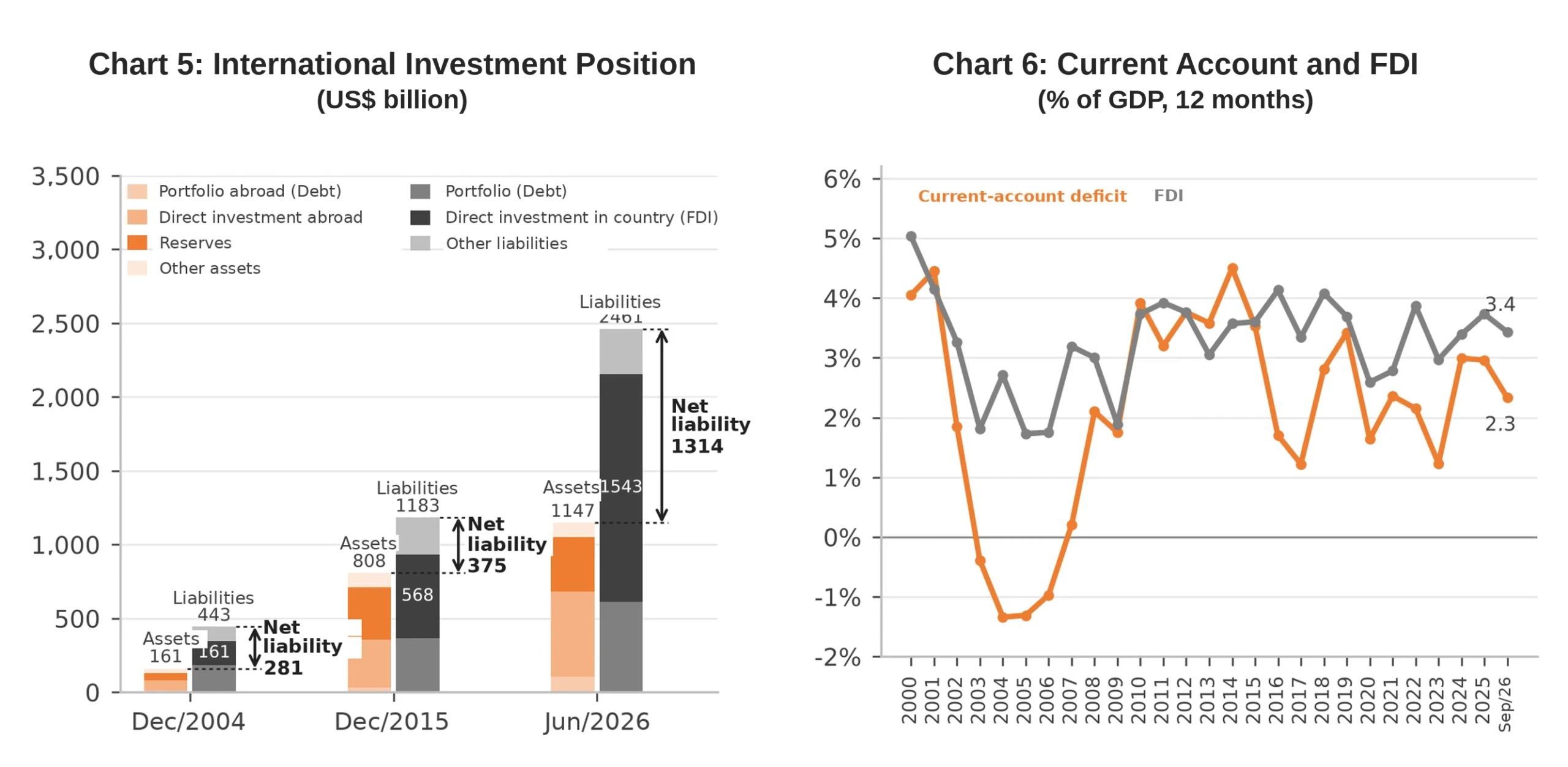
This means that, for a country that needs to absorb foreign savings in the form of a current-account deficit, it is much better for this to be financed by foreign direct investment than by debt (Chart 6). In other words, the composition of liabilities matters in determining whether a shock to the exchange rate will be amplified or moderated, depending on the quality of the resources that foreign investors have allocated to the country.
Chart 5 shows that in 2004 the net external liability (US$ 281 billion) exceeded the stock of foreign direct investment (US$ 161 billion). This means the country had to resort to borrowing, in net terms, to finance its dissaving. By 2015 this ratio was already healthier: US$ 375 billion of net external liability against US$ 568 billion of direct investment. We currently have a stock of direct investment on the order of US$ 1.54 trillion, higher than the net external liability of US$ 1.31 trillion. Another interesting figure to watch is net external debt (debt liabilities minus debt assets and international reserves). It went from US$ 189 billion in 2004 (28% of GDP) to US$ 130 billion in 2015 (7%) and back to US$ 351 billion (14%) in June 2026. This is an important point of attention.
When we speak of the benefit of holding international reserves, we are not referring only to the capacity to generate foreign currency to provide liquidity to the market and honor external commitments. Any initiative to sell dollars to contain the exchange rate in moments of uncertainty can have the benefit of containing volatility and preventing market dysfunction.
But there is always a cost. As a general rule of thumb, when the stock of direct investment exceeds the net external liability, exchange-rate depreciations reduce the value of the latter, measured in foreign currency, which works as a countercyclical mechanism. In the opposite case we have a pro-cyclical dynamic, a vicious circle.
The Public Sector’s Exposure
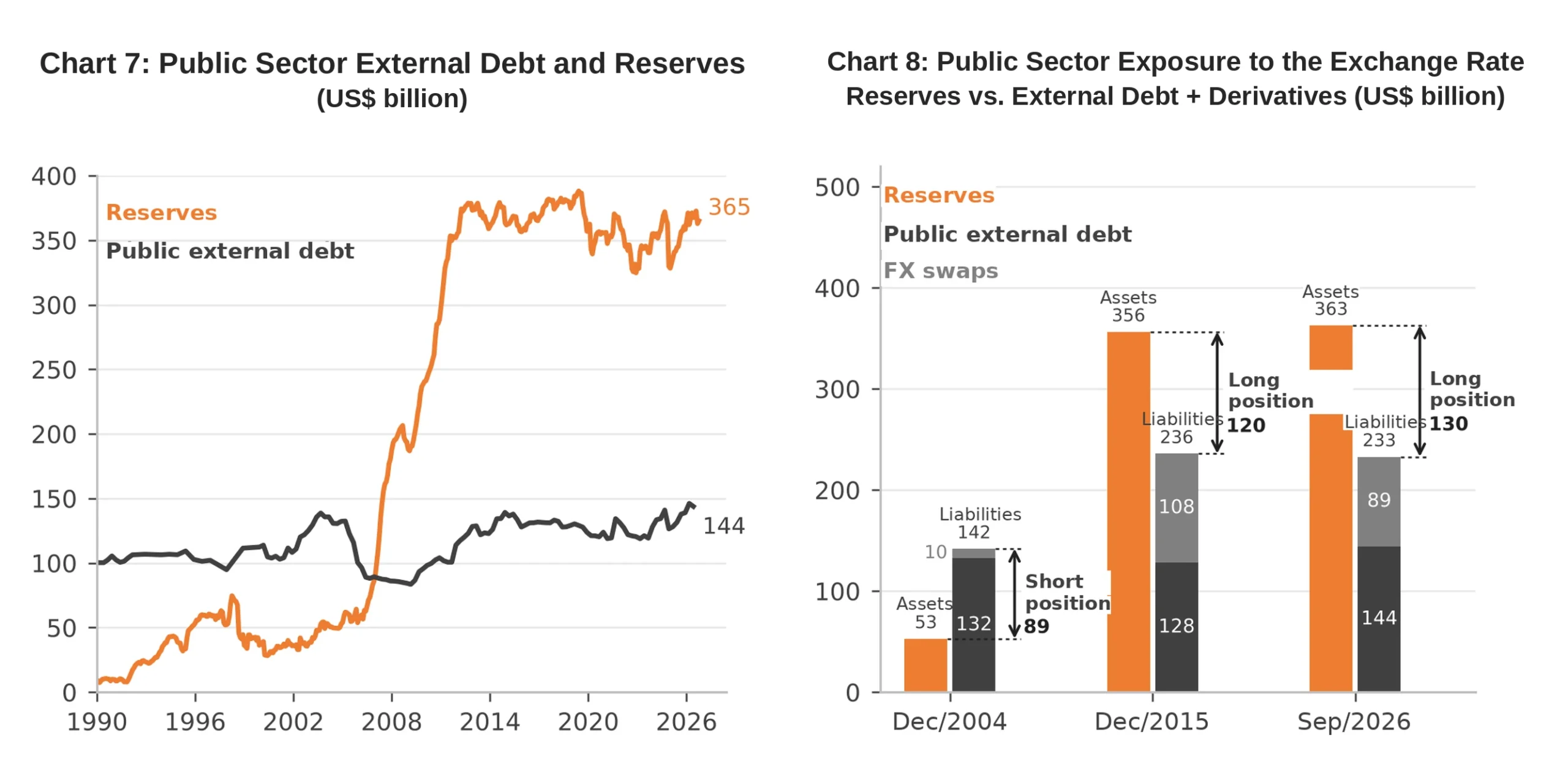
In the event of some shock that is related to — or that ends up triggering — distrust regarding the fiscal accounts, the international reserves position is even more important. Chart 7 shows how the relationship between the public sector’s external debt and international reserves has evolved since 1990. The cushion built up over time was essential to establish credibility regarding the National Treasury’s ability to honor its commitments in foreign currency.
In several moments of uncertainty, reserves were used to reduce the volatility of the foreign-exchange market. But we know that the Banco Central has been making use of derivatives: the Banco Central’s promise to exchange reais for dollars on a future date at a predefined price (FX swaps, futures contracts and credit-line auctions).
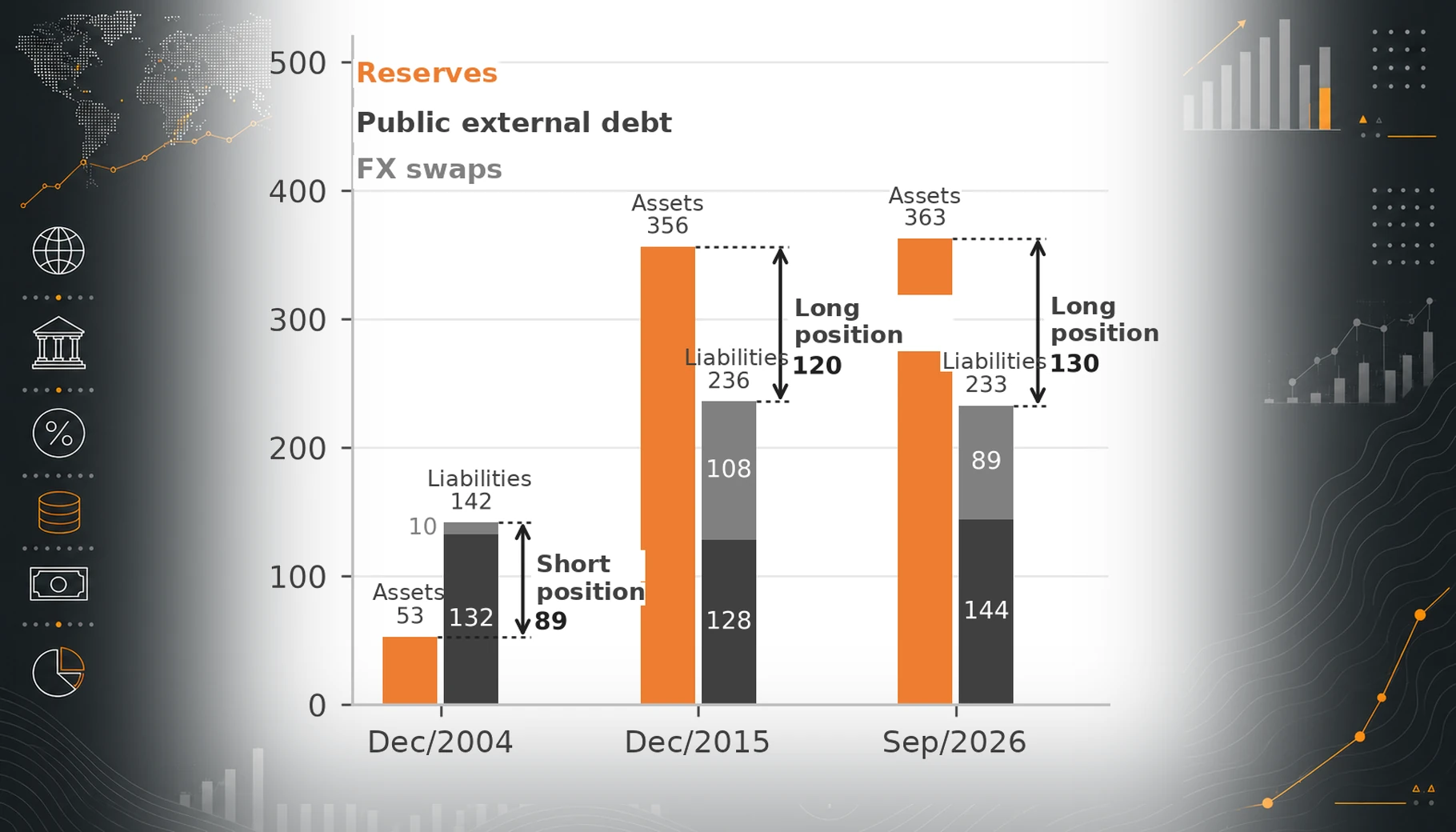
This means it is not enough to track the debt-to-reserves relationship in Chart 7. One must also observe the public sector’s position in FX derivatives, such as the one shown in Chart 8. The same logic described earlier applies here. When the public sector is a net creditor of foreign-currency assets, a rise in the exchange rate will reduce the net debt measured in reais, so that the depreciation improves the fiscal fundamentals, which works as a vector for reducing distrust.
That is why extreme care is needed when reducing the long position in foreign currency, whether by selling reserves or by overusing derivatives. There is an enormous risk that a more fragile balance sheet will put the country on a path to rupture in the event of distrust affecting the foreign-exchange market.